The
film ‘Made in Britain’, by Tim Roth in 1982 showed the world through the eyes
of a juvenile skin head boy of the 80’s. The moral throughout the film was
obvious, the fact that no one can overthrow an organisation in a higher
position that you is a universal issue people face. I found it interesting how
if I was watching this film 5 or 6 years ago I'd of looked at it in a completely
differently way. Then I was still an adolescent who thought I knew best, I
would have idolised the brash rebellious character, thinking the things he
was doing was fun and right in telling the ones in charge where to go. In
contrast to this however, now I just found his actions frustrating. Knowing
that he doesn't yet understand the consequences and the regret he will feel in
the future irritated me. The use of dramatic irony, knowing the road the
character is going down is not a good one, is only apparent depending on who’s
watching. The reaction of this film all depends on the audience.
Friday, 21 November 2014

Sunday, 9 November 2014
Relief Printing
Relief printing was a new experience for me and I was excited to begin. Rather than just cutting one lino and sticking to that design, I moved onto a further 2 linos. This allowed me to experiment further and gain a variety of development processes. I found it easy to get my head around the fact the concluded print would be the opposite way round to the lino cut, this meant that any text I was to add would be backwards. Although this wasn't challenging, I found it extremely challenging trying to understand how to add various tones to the print. After buying my paper that would be used for the final print, I started to plan what colours will be used first. I realised that this was easier said than done as I began to realise more needed to be added after I had cut the design away. This, for me, was distressing however I worked around it and the outcome wasn't that bad considering. The fact that I can't digitally manipulate the print as that would ruin the whole idea of old fashioned broadsides, I had to face the fact that that's as good as it's going to get. On the bright side however I found that the smudgy finger prints and the lack of some detail and high colour tones that would of defined and concluded the design, all relates to the simplistic designs of the first ever broadsides. Overall I admit that my final was not the most professional finish in the world, however I am confident that practice makes perfect.
Thursday, 30 October 2014
The Anatomy Museum
Visiting the University of Edinburgh’s Anatomy Museum was
interesting if not a little unnerving for someone who doesn’t usually draw
amongst brains and skeletons. I found the change refreshing and it gave me the
opportunity to broaden my mind towards my anatomy project. Whilst in the
presence of juvenile skeletons and partially decomposed heads, it was a stark
reminder of mortality and what is to come. I found the reactions of myself and
my classmates interesting, some weren’t phased whereas others like myself
grimaced. It made me wonder why I found it disturbing. I have always had a
phobia about death and all things related to it, which in essence involves the
human body and how it works. I contradict myself however as I thrive off gory
films and all things sinister, perhaps that’s where my anxiety has derived
from. I used to suffer severely from panic attacks; anything from driving past
my local Toys ‘R’ Us to watching Tarzan used to trigger them. As I have gotten
older I have learnt to control my thoughts however sometimes it is inevitable.
All these thoughts and reflections reminded me of the poet Emily Dickinson. It gave
me the idea to incorporate her literature alongside my work as I am very fond
of her and she can relate. I am looking forward to the next museum visit.


Thursday, 16 October 2014
The Bauhaus
The
Bauhaus
Famous
for its relationship with modernism and mapping the creative output that we
have today, the Bauhaus School of Design in Germany emerged at a time revolved
around sheer social upheaval. “Between 1920
and 1930 Modernists throughout Europe argued violently through letters,
articles and personal confrontations and by 1935 they had drifted apart in
terms of their actual design work.” (Greenhalgh, 1990:6)
Founded in Weimar by Walter Gropious in 1919, the pioneer
phase was c1919 – 1930. Greenhalgh had 12 terms of definition for the pioneer
phase, one of which was ‘Internationalism’. They aimed to change society for
the better, creating opportunity to change the structure of art and design
education. With other masters such as Adolf Meyer (rationalism) and Johannes
Itten (mysticism), the difference in views caused variation in ideology. “The
Basic Course” emphasised practical formal teaching, the study of materials,
observation and composition. The process of moving up each year whilst
narrowing your specialism down, “If he is to work in wood, for example, he must
know his materials thoroughly.” (Cited Naylor)
The Bauhaus Manifesto (1919) was a promotional campaign positioning
their ideologies. The building reflected a new way of thinking and in itself
was a big part of the experience. In 1925 they moved to Dessau, the most influential and well known
building when people think of Bauhaus. It was created to fit into the new-found
technology, new politics and new ethos. It focussed on light and function and
was central to everything they did whilst they shifted from craft to industry.
 |
| Analytical drawing, Ida Kerkovius. http://bauhaus-online.de/en/atlas/werke/linear-analysis-of-a-still-life |
Early experimentation and the rise of collage were aesthetics
of urbanism. (paul citroen the big city)(Werner Graeff composition 2)
Experiments began to form using collaborative work between music, art and film
students. Looking at this in present day as an illustration student, my first
thought was, ‘Really…?’ However, this philosophy can relate to Oskar
Schlemmar’s Triadic Ballet (1923); I can respect that this was where it all
started. Another revolutionary discovery was Herbert Bayer’s Universal Type (1923.) His belief
mirrored that of artists; that type should follow the technology. The need for
thick and thin bars in lettering was no longer needed due to new mechanical
printing technology i.e. Times New Roman. Bayer’s Universal type also
represented the desire for a non-hierarchal society whilst the Bauhaus
attempted to break away from class divisions (the idea that a glassmaker is
better than a woodcutter.
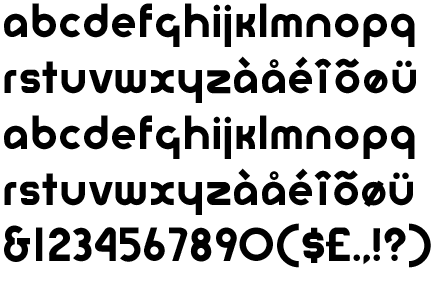 |
| Bayer's Universal Type http://marcleacock1.wordpress.com/2011/10/21/ what-was-the-underlying-principle-behind-herbert-bayers-universal-alphabet/ |
The legacy of the Dessau years comes through furniture,
domestic products and structural integrity. “From their experimentation will
evolve standards for industrial production.” (Gropious 1923) Haus am Horn is
significant in seeing the shift as well as Marcel Breuer’s club chair. Their inspiration came
from the economy of materials and function, reducing the amount of materials,
aimed for mass production. The kitchen design in Haus am Horn (1923) shows the
new contemporary idea of rationalising how they use spaces. In present day we
contradict the Bauhaus’s desires and intentions, they designed for the masses
yet it costs £200+ for a reproduced design of a chair and X amount for an
original Bauhaus piece. Mass production is not how it used to be not only is it
a way to create cheap and low quality products, people no longer want what
everyone else has. Up/recycling is the new craze. This links to the lack of
desire to be caught in the mainstream of society today. Although this isn’t the
only reason for the desire to purchase cheap second hand furniture, people look
for quality pieces that can last years and years, unlike the MDF bookshelf from
IKEA.
The value of Bauhaus has changed radically compared to how
it used to be. Objects designed and made by them are now seen as a statement to
have and people pay thousands. The contrast between designing for everyone and
now it being a symbol of wealth represents how we have completely turned the
Bauhaus’s desires upside down. We haven’t in respect to The Basic Course
however if I was to buy a Bauhaus kettle I most certainly would never use it.
Friday, 10 October 2014
John Fardell
 |
| http://twoheadedthingies.blogspot.co.uk/ 2012/09/is-it-bad-nah-its-wicked.html John Fardell Viz Magazine |
Cartoonist
and illustrator, John Fardell, visited today to talk to us about his work. He
discussed past experiences and explained about how he had always wanted to be
in this line of work. However, like the usual aspiring artists, he got informed
to take a more ‘sensible’ route, which he didn’t. This lecture definitely
enlightened me, I have ideas of my own and I feel a great deal more confident
in how I am going to achieve my goals.
John
Fardell eventually went down the route of creating cartoon takes on articles; cynical
and witty comic strips for Viz Magazine and Liss Magazine. He created a
connection between Charlie Chaplin and comic strip work - you can learn a lot
from silent movies; narrating a story through pictures. The less need for
words, the better. He doesn’t feel the need in telling a story twice though
literature and imagery.
 |
| http://www.fantasybookreview.co.uk/ /The-Last-of-the-Sky-Pirates 2014 |
 From
the age of 13, he’d write to storybook publishers his ideas to get a polite and influential
decline. Though after getting his name in a few magazines and illustrating a
few of his Dad’s articles, he got his foot in the door of children’s books.
Still they weren’t picture books, they were chapter books so he could design
the front cover and create a number of black and white illustrations. His books
reminded me so much like various Steampunk novels that have always influenced me such as
The Last of the Sky Pirates illustrated by Chris Riddell. He got to create fictional vehicles
and all things deemed fantastical however he struggled in figuring out the
perspective of an object that doesn’t exist. This caused him to create his own
3D mini sculptures in order for him to successfully create the write depth and
angle of his designs.
From
the age of 13, he’d write to storybook publishers his ideas to get a polite and influential
decline. Though after getting his name in a few magazines and illustrating a
few of his Dad’s articles, he got his foot in the door of children’s books.
Still they weren’t picture books, they were chapter books so he could design
the front cover and create a number of black and white illustrations. His books
reminded me so much like various Steampunk novels that have always influenced me such as
The Last of the Sky Pirates illustrated by Chris Riddell. He got to create fictional vehicles
and all things deemed fantastical however he struggled in figuring out the
perspective of an object that doesn’t exist. This caused him to create his own
3D mini sculptures in order for him to successfully create the write depth and
angle of his designs.
Fardell
focussed mainly on his book “The Day Louis Got Eaten.” It put things into
perspective on how much time it can take to create a picture book. His way of
working is precise and slow with a lot of rough drafts before the final main
image which contrasts massively to Quentin Blake who does a few quick solid
sketches until he gets one he likes. It’s interesting how different people and
how different the outcomes are yet both work just as well as the other. As we
went through the book, the importance of page turners became apparent. The need
to have a hint of something happening on the next page; enough to show
something is there however not enough to give it away. Some hints you don’t
even notice until you go back and read it again. He went through a lot of
drafts and implications that the illustrations had, and he explained how he
solved them. I felt like I could relate to all of this, it excited me how I could
understand someone like a mathematician understands equations.
I
learnt a great deal about techniques and various mediums. The direction in
which a book’s pictures flow can sometimes be extremely effective and psychologically
purposeful. The fact we read left to right means that the rule can also apply
to illustrations and their characters. The same rule applies to film makers, if
someone is battling the elements, they can be seen walking left across the
screen, which we could relate to as quite a struggle. Louis’s sister was always
travelling right across the book until the end when they turned left back
towards home.

A
problem I always had whilst painting has suddenly been solved as well. The fact
I have only just found out about water colour ink due to Fardell’s recommendations
makes me question myself as an illustration student. I have always painted
first then applied pen after, I am so excited to purchase some waterproof ink
and try it out using a dip pen which he also recommended to us. I have always
questioned my ability when using technology too when enhancing/creating my
work. I have avoided Photoshop like the plague however I have been shown how it
can be an implicitly useful tool. He also referenced artist William Heath
Robinson as an inspiration.
.jpg) |
| William Heath Robinson (1872 - 1944) 'The Nightingale' http://literature.wikia.com/wiki/The_Nightingale |
Overall,
this lecture left me feeling elevated, educated and motivated.
Tuesday, 7 October 2014
Revel Archive
Today we visited the research centre in the Main University
Library to investigate a collection of ‘Revel’ party invitations from the
archives. We also watched a short silent film on one recording of a Revel
party. The Revel Christmas party has happened once a year for the Edinburgh
College of Art since the 1920’s and each year students collaborate to create an
invitation. This was extremely interesting as they were set out chronologically
so you can see the change in designs clearly. The first few were traditional
however it then progressed to more decorative and thought out designs. This was
when the students were allowed to take over.
The short film was interesting although also disappointing.
The much more naïve and playful behaviour displayed made me question what had
changed. Whilst looking at our expressions, and my own, we were confused as to
why they were doing the things they were doing for entertainment. Another thing
that didn't help with this gutted feeling is that the invites now are simply
slips of paper. Yes we still get the opportunity to design the flyer however
the invitations had always been just as special. It’s like our society don’t
get excited over singular events such as this anymore. There are bigger and
better things to do and a party isn’t a party without sharing it with everyone
online. Watching the film made me wonder where the magic had gone. Admittedly I
love traditional things so perhaps that’s why I feel like this. It’s like when
people have short hair, they want long hair, when people have long hair, and
they want short hair. I have yet to attend a Revel party so maybe I’m being
a bit hasty.
Nonetheless the flyers and invites were all beautiful in their own rights, they were extremely interesting to look through. Also looking at the fashion from the photo's made me think about the lectures I had had previously.
Nonetheless the flyers and invites were all beautiful in their own rights, they were extremely interesting to look through. Also looking at the fashion from the photo's made me think about the lectures I had had previously.
Fashion Modernity
Society began to focus on new attitudes towards women.
Fashion and the healthy body collaborated and reflected the social and cultural
changes taking place in the 20th Century. Fashion had always
expressed wealth and identity, Queen Elizabeth I from the 15th
Century had lavished in fine cotton and jewellery during the making of her
portraits; her clothes demonstrated her wealth and power.
Growing urbanisation in the 19th Century caused
anonymity, people began to want to stand out. For the German Sociologist, Georg Simmel, the rapid
development of fashion was bound up with growth of city life and individualism, "The deepest problems of modern life derive from the claim of the individual to preserve the autonomy and individuality of his existence in the face of overwhelming social forces, of historical heritage, of external culture, and of the technique of life."(http://www.brainyquote.com) The system of imitation allowed people to be part of a group or clique. I found
it interesting that he argues that there is no escape from fashion. Those who
declare to be unfashionable are simply engaging in a form of imitation, which
may itself become ‘fashionable.’
This is evidently a universal thing as I can
agree with that idea in present day.
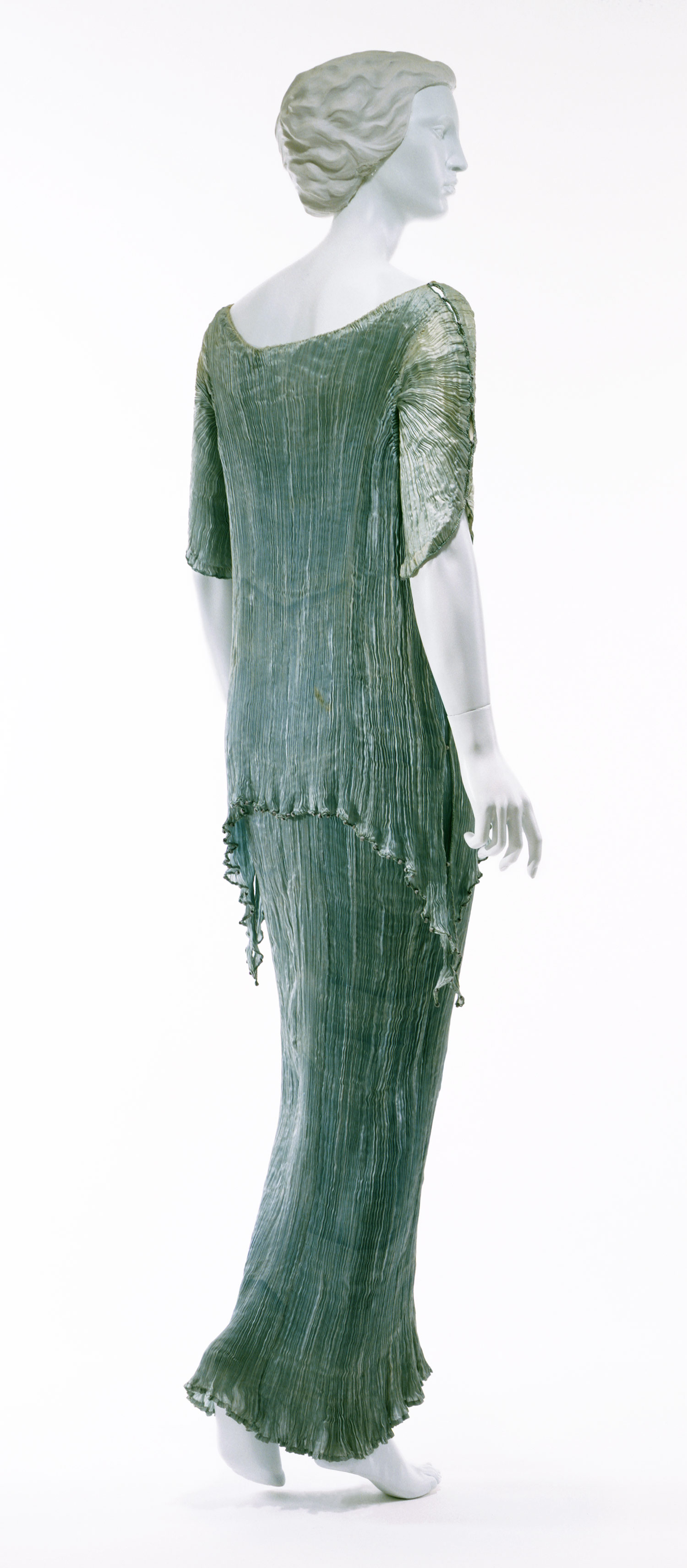 |
 1979.344.11a,b)". In Heilbrunn Timeline of Art History. New York: The Metropolitan Museum of Art, 2000www.metmuseum.org/toah/works-of-art Oct. 8th(Below Above) Paul Poiret and Denise,Zouave dressCopyright Lipnitzki/Roger-Viollet/Getty Images |
 |
| Palmolive advert 1924 http://www.vintageadbrowser.com/ beauty-and-hygiene-ads-1920sPalmolive Company’s Palmolive Soap |
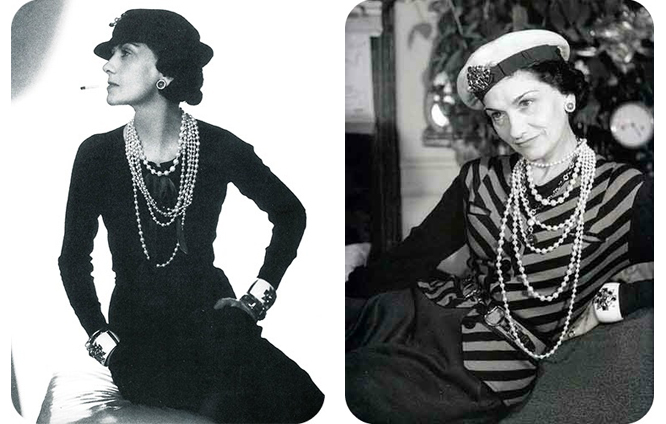 |
| Gabrielle Bonheur Chanel http://www.vintagedancer.com/ /1920s/1920s-style-guide-womens-fashion |
The modernist response, The Bauhaus, was rather anti-fashion. The
experimented with new materials, not directly concerning them with fashion. Oskar Schlemmer and the Triadic
Ballet showed modernist preoccupation with the machine, only symbolic
movements and geometric shapes where expressed. Actors were reduced to singular
jagged movements like puppets on a string. This was fashion in an art form,
some in society craved the need to be different, to stray themselves from the
mainstream current. You could say fashion is innovation gone mad, the superficial side of it
has created judgement and discrimination universally. However some argue with
this.
 |
| http://jocelinehowe.wordpress.com//2013/08/26/triadic-ballet-oskar-schlemmer-1927/ Oskar Schlemmer's dances (1927) Aug 2013 |
Uploaded on 21 Feb 2012
A film in three parts after Oskar Schlemmer's dances (1927)
Book and Choreography: Margarete Hasting, Franz Schömbs, Georg Verden.
Rehearsal: Hannes Winkler.
Reconstruction of the costumes: Margit Bárdy.
Art Consulting: Ludwig Grote, Xanti Schawinsky, Tut Schlemmer.
Dancers: Edith Demharter, Ralph Smolik, Hannes Winkler.
Music: Erich Ferstl.
Camera: Kurt Gewissen.
Cut: Johannes Nickel.
Production Director: Helmut Amann.
Production: Gottfried Just.
Monday, 29 September 2014
Modernism and the Machine
Progress and Efficiency
Frederick Winslow Taylor thought he was designing a new world when he developed a working system known as Taylorism. This is what we see now in warehouses, people stood by conveyor belts for umpteen hours per day. He argues that dividing labour roles so that each person repeated the same small task continuously would make for progress in the work place. Henry Ford used this new assembly line system as it went from taking 12 hours to 2 hours to make one of his cars. This method also requires no extra skills as it is doing the same thing over and over again. German Trade unionists were concerned that this would dehumanize people, "Life is not determined by consciousness but consciousness by life." Quoted by Marx in Shaw (2008), the idea of "alienated labour." William Morris also criticised the idea, "Apart from the desire to produce beautiful things, the leading passion of my life has been and is hatred of modern civilization.” How I Became a Socialist, William Morris
Anxiety and the Machine
Women, nature and the machine had become a mass of significations which all had one very existence: otherness; by their very existence they raised fears and threatened male authority and control - Hayssen, A. (1980) After the Great Devide: Modernism, Mass Culture and Post Modernism, London P70.
Modernism and the Machine
Bauhaus Art School (1919 - 1933) were the next generation in design.
Modernist design favoured:
- Progress
- Democracy; designs affordable for the average person
- New technology
- New materials
- Simple lines
- Rational forms
- Abstract and Geometric
- Less is more
- History
- Elitism
- The hierarchy of fine arts over the world
- Equality (not being able to physically see who is rich and poor from their clothes/belongings
 |
| The Weissenhoff Estate designed by 17 Architects. Art Deco Evan. (2009). DE STIJL ARCHITECTURE. Available: http://cosmogeny.wordpress.com/2009/02/09/de-stijl-architecture/. Last accessed 29th Sep 2014. |
 |
| Grete Schütte-Lihotzky and Ernst May, “Frankfurt” Kitchen, 1926-1929Adam M. (2010). Art History. Available: http://www.studyblue.com/notes/note/n/ah235/deck/113880. Last accessed 29th Sep 2014.
Constructivists celebrated industrial and political symbols for example Lyubov Popova and Varvara Stepanova.
|
 |
| Varvara Stepanova poster Wiki. (2010). Varvara Stepanova. Available: http://www.designishistory.com/1920/varvara-stepanova/. Last accessed 29th Sep 2014. |
 |
| Lyubov Popova Abstract Painting Wiki. (2014). Lyubov Popova. Available: http://en.wikipedia.org/wiki/Lyubov_Popova. Last accessed 29th Sep 2014. Futurist Movement: Radicalism
Expressive use of words, "Abolish even punctuation"
|
Saturday, 27 September 2014
The Illusionist Review
 |
| The Illusionist Poster (2006) Wikipedia.org |
The Illusionist (2006) Directed by Neil Burger has the same moral
story as the one from the fable “The Most Incredible Thing.” The undertones of
corruption in the patriarchal society of the 19th Century is
consistent throughout the film. The way the actors portrayed the people
mirrored the attitudes they would have had well. During this period, society
had started to become more cynical towards magical things, referring to them as
‘illusions’ or ‘tricks’ rather than ‘special powers.’
With this skepticism also came an intellectual reaction against
received authority, for example when the public protested after the arrest of Eisenheim or when he stood up to the police and said the Highness had murdered Sophie.
“Are you completely corrupt?”
“No, not completely, no, which is why I advise you to not accuse any
one, especially his Imperial Highness or you ought to end up in jail yourself.”
That contradictory comment is extremely frustrating, it is the epitome
of what an implicit dictatorship is all about, with power comes corruption.
This problem is still apparent in present time; from the protests in Hong Kong
this weekend to the situation in Iraq. The challenging storyline gives me the
ever-circling question: Is the Heir a bad character? I’m straining to think
back to when he’d been awfully wrong. I understand that he was planning to
overthrow his Father and he wanted Sophie to gain control of Hungary however
this isn’t a violent act nor would it devastate much as he seemed to know what
was good for him and others.
Although I could express my enthusiasm towards the amazing costume and
prop design as well as the characters and storyline in depth, I can’t help but
focus more on the universal problem; when will democracy be what it really means?
Thursday, 25 September 2014
Anatomy Project: Drawing From Life
This project is about observation. I have a journal separate from my other projects and briefs, this seems more personal however still educational. The process of this book will be from my own actions and thoughts however I also plan to develop my skills in capturing emotion and telling a story from single observational sketches. "...they are a place to play, a
safe haven away from our embedded editor. We vent and brainstorm and try
I travel a lot and I am constantly on trains and waiting on platforms. This could be a good direction to go towards.
safe haven away from our embedded editor. We vent and brainstorm and try
on different guises in our journals." Jennifer New (2005). Drawing From Life: The Journal as Art. China: Princeton Architectural Press. 13. Illustrator John Clapp also made a point similar to this, "Journals, they are a collection of things I’m curious about, like the Smithsonian: ‘the attic of mankind.”Jennifer New (2005). Drawing From Life: The Journal as Art. China: Princeton Architectural Press. 13. I researched him and found that he has beautiful examples of what a journal can look like, his observational drawings are complemented by text and quotes. Singular words jump out at you whilst you get a feel of the place he'd been.
I travel a lot and I am constantly on trains and waiting on platforms. This could be a good direction to go towards.
Tuesday, 23 September 2014
Modernism & After
When we think modern we think of new and improved things,
the latest gadgets and contemporary design. However, modernism revolving around
Western culture is in fact classed as between 18th and 19th
century, with the 17th to the 18th century being the
Enlightenment era. A quote by philosopher, economist and sociologist, Karl Marx
(1818 – 1883) highlights exactly what is meant by the idea of modernism – “All
that is solid melts into air.” The idea that everything is constantly changing
challenges the concept of the word ‘modern.’ From the writer H.G. Wells, "The crisis of today is the joke of tomorrow" (1920) up to
Politian Tony Blaire, “The scale of challenges now dwarf what we faces in 1997”
(2008) it shows that the changes in which we face and have face have been and
will continue to be consistent.
During the Enlightenment period, the importance of
rationality and science rather than faith, superstition and tradition surfaced.
Intellectual reaction against received authority i.e. The French Revolution.
The need for progress, the thriving optimism and desire for absolute knowledge
became the step towards the industrial revolution (1760 – 1840). Areas changed
from rural to urban with new working and living conditions. There were
factories, mass production and major transformation. However with that came
social alienation, this caused the growth of railways and transport.
The Arts and Crafts Movement was dominant during this period.
(Stenburg Bros.: Man With a Movie Camera poster.) Modernism in Visual
Communication became surreal, graphic and fragmented. This contrasts to the
usual detailed, fantastical and classical illustrations that once were. Now it
would involve mixed media and edgy design, espousal of the new and rejection of
history and tradition. It was the utopian desire to create a better world from
scratch. With design came the almost messianic belief in the power and
potential of the machine and industrial technology; rejection of applied
ornament and decoration, an embrace of abstraction.
 |
| Skandium. (2010). Miature zig zag.www.skandium.com/miniature-zig-zag-stoel. Last accessed 23rd Sep 2014. |
Modernism and revolution in architecture and design revolved
around form following function, Louis Sullivan, also known as 'the father of modernism' was the creator of the skyscraper. Another example of basic functional design is the Zig Zag chair designed by Gerrit Rietveld in 1934, objects and designs are now legacies from a previous original idea. Traditional design had been replaced with contemporary. Another example would be the iPod and the record player, both have the same function however one is more practical.
 |
| Cargo. (2010). Industrial Revolution Illustration.http://ben-jennings.com/Industrial-Revolution-Illustration. Last accessed 23rd Sep 2014. |
 |
| Cargo. (2011). Photomontage: A collection. http://cargocollective.com/mat200a/Photomontage-A-Collection. Last accessed 23rd Sep 2014. |
We as humans want to make our mark in the world. From the
cave drawings around 30,000 years ago to graffiti today, we are continuously influenced by what is
around us and what is to come. Cartoonist, Ben Jennings illustrates what is around him. He
has a series of pictures created from the influence of the industrial
revolution. Current artists today are influenced by photographs and drawings
from those who created art subjected by their society at the time, thus the
paradox continues. Alexander
Rodchenko is one of many examples who were part of the change.
Modernism is an umbrella term for a wide array of movements
which mostly occurred after the World War, characterised by changing attitudes,
innovation and freedom from realism.
Subscribe to:
Posts (Atom)